Australia's Population
The estimated resident population for each state and territory at 31 March 2023 was as follows:
 Australia National Total; 26,473,100
New South Wales 8,294,000;
Victoria 6,766,600;
Queensland 5,418,000;
South Australia 1,844,600;
Western Australia 2,855,600;
Tasmania 572,700;
Northern Territory 251,700; and
Australian Capital Territory 464,600.
Australia’s Ageing Population
Australia’s population, like that of most developed countries, is ageing as a result of sustained low fertility and increasing life expectancy. This is resulting in proportionally fewer children (under 15 years of age) in the population. The median age (the age at which half the population is older and half is younger) of the Australian population has increased over the last two decades, from 32.1 years in 1990, to 38.5 years in 2022. Between 30 June 2009 and 2010 the median age remained relatively steady at 36.8 years. Over the next several decades, population ageing is projected to have significant implications for Australia, including for health, labour force participation, housing and demand for skilled labour.
The ageing of Australia’s population, already evident in the current age structure, is expected to continue. The median age of Australia’s population is projected to increase to between 38.7 years and 40.7 years in 2026 and to between 41.9 years and 45.2 years in 2056 .
At the last census, The median age for capital cities (37.2 years) was younger than the rest of Australia (42.0). Adelaide was the oldest capital city with a median age of 39.4 years, ahead of Hobart at 38.8.
South Australia also had the oldest population of all the states and territories with a median age of 46.8 years. The second oldest was Tasmania with a median age of 44.7 years, followed by Victoria (43.2 years), New South Wales (42.5 years), Queensland (40.8 years), Western Australia (40.3) the Australian Capital Territory (38.5 years) and the Northern Territory (32.1 years).
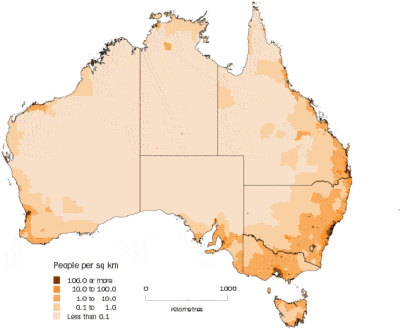
Most of Australia’s population is concentrated in two widely separated coastal regions. By far the larger of these, in terms of area and population, lies in the south-east and east. The smaller of the two regions is in the south-west of the continent. In both coastal regions the population is concentrated in urban centres, particularly the state and territory capital cities.
Australia’s Population density
- People living in the capitals increased by 2.5 million (17%) between 2011 and 2021.
- Melbourne had the largest increase (806,800), Darwin grew the least (19,700).
- Canberra had the highest growth rate (23%), Adelaide had the lowest (11%).
- Regional Australia grew by 832,000 (11%).
Population density varies greatly across Australia. Australia’s total population density at June 2021 was 3.3 people per square kilometre. Among the states and territories, the Australian Capital Territory had the highest population density at 192 people per square kilometre and the Northern Territory had the lowest population density at just 0.18 people per square kilometre.
At 30 June 2022, population density was highest in the capital cities of Australia’s states and territories.
With the exception of Canberra, all these capital cities are located on the coast.
Population density in other coastal and surrounding areas was also relatively high, particularly in the southeast corner of the country. On the other hand, most of central and western Australia had a population density of less than one person/km2.
Five of the top ten most densely-populated statistical local areas (SLAs) were located in Sydney, which is currently the most populous city in Australia. At 30 June 2022, the Sydney statistical division had a population of 5.3 million people.
Australia’s Sex Ratio
Darwin was the only capital with more males than females with a sex ratio of 105.8 males per 100 females. At June 2022, the estimated national sex ratio in Australia is 99 males per 100 females. The sex ratio of the states and territories at June 2022 varied from 95.8 in Tasmania, up to 105.8 in the Northern Territory.